August 15
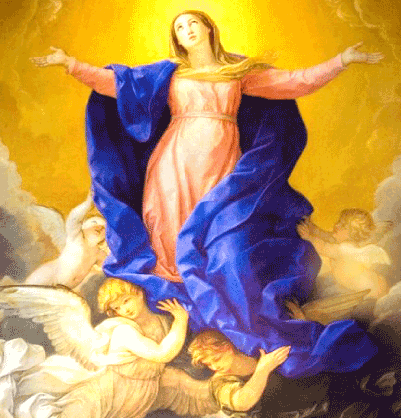
"Finally the Immaculate Virgin, preserved free from all stain of original sin, when the course of her earthly life was finished, was taken up body and soul into heavenly glory, and exalted by the Lord as Queen over all things, so that she might be the more fully conformed to her Son, the Lord of lords and conqueror of sin and death." CCC 966
The Assumption of Mary is one of the four Marian dogmas of the Catholic Church. The Feast of the Assumption of the Blessed Virgin Mary is celebrated in the Roman Catholic Church on 15 August, whilst the Eastern Orthodox and Eastern Catholics celebrate the feast as 'Dormition of the Mother of God (or Dormition of the Theotokos, the "falling asleep of the Mother of God") on the same date, preceded by a 14-day fasting period. Eastern Christians believe that Mary died a natural death, that her soul was received by Christ upon death, that her body was resurrected after her death and that she was taken up into heaven bodily in anticipation of the general resurrection.
Teaching of the assumption of Mary was widespread across the Christian world, as early as the 5th century. The feast began to celebrated in Rome in the middle of the 7th century. According to the 'Passing of the Blessed Virgin Mary', attributed to Joseph of Arimathea, which is a later version of the Virgin Mary's Dormition, probably from sometime after the early seventh century, one of the apostles, often identified as Thomas the Apostle, was not present at the death of Mary but his late arrival led to a reopening of Mary's tomb, which was found to be empty except for her grave clothes. Subsequently, it is believed, that Mary dropped her girdle down to the apostle from heaven as testament to the event thereby confimring her bodily assumption into heaven.
Though the feast and belief of the assumption of the Blessed Virgin Mary into heaven was celebrated in many parts of the Church, it was not until November 1950 that the Holy Pope declared it as a dogma. There is an interesting event that led to the proclamation of the dogma. On 1 May 1950, Gilles Bouhours, a Marian seer, reported to Pope Pius XII a presumed message that the Virgin Mary would have ordered him to communicate to the Pope on the dogma of the Assumption of the Holy Virgin Mary. It is said that during the Holy Year of 1950, Pope Pius XII had asked God for a sign that could reassure him that the dogma of the Assumption of the Virgin Mary was actually wanted by God and when Gilles communicated the message to Pope Pius XII, the Pope considered this message the hoped-for sign. Six months after the private audience granted to Gilles, Pope Pius XII proclaimed the dogma of the Assumption of body and soul of the Blessed Virgin Mary into Heaven.
On November 1, 1950, Pope Pius XII declared the Assumption of the Virgin Mary as a dogma of faith with the apostolic constitution Munificentissimus Deus as follows:
"We pronounce, declare, and define it to be a divinely revealed dogma: that the Immaculate Mother of God, the ever Virgin Mary, having completed the course of her earthly life, was assumed body and soul into heavenly glory."
Pope Pius XII further expressed in his apostolic constitution the hope that the belief in the bodily assumption of the Virgin Mary into heaven "will make our belief in our own resurrection stronger and render it more effective".
In the Apostles’ Creed, we profess our faith in the “Resurrection of the body” and in “life everlasting”. This is the ultimate goal and meaning of our life’s journey. This promise of faith is already accomplished in Mary, who is the “sign of sure hope and comfort”. Since death and the corruption of the human body are consequences of sin, it was not right that the Virgin Mary – who is free from sin – should be affected by this natural law. Hence the mystery of her “Dormition” or “Assumption into heaven” was most appropriate. With her, and like her, we too, who are God’s creatures, will one day be there too. Mary’s destiny, united to the transfigured and glorious body of Jesus, is, therefore, the destiny of all those who are united to the Lord Jesus in faith and love.